
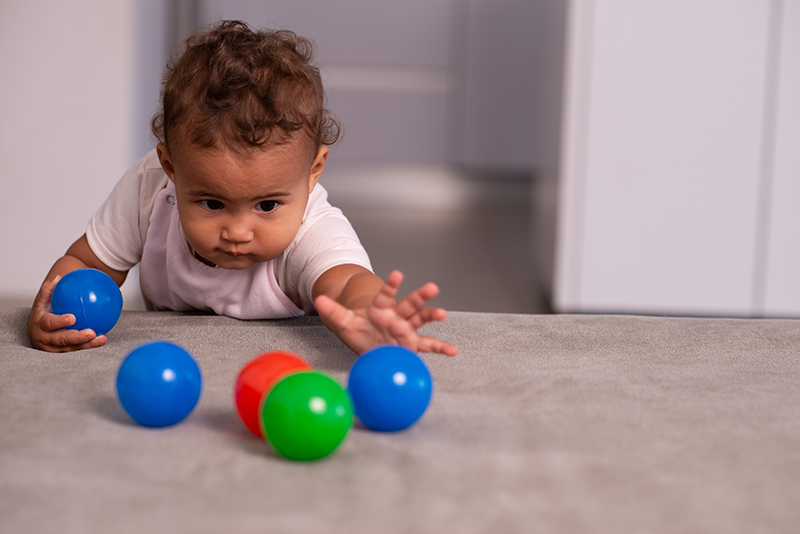
Infants use adult’s actions, prior knowledge, and physical cues to understand the world around them.
Learning to use our bodies is no small feat. Babies learn by watching adults and by trying things out themselves – often over and over! New research from I-LABS visiting scientist Dr. Áine Ní Choisdealbha, in collaboration with I-LABS co-director Dr. Andrew Meltzoff, now shows that babies’ own fine motor skill (such as the ability to grasp an object with their hand) is connected to how the infants understand other people’s goals.

Dr. Ní Choisdealbha said, “Motor skills prior to language are one of the most important aspects of human development in the first year of life. Parents are universally curious about infant reaching, grasping, crawling, and walking. You can learn a lot about how a baby thinks by watching how they watch the reaching-and-grasping of others. The new discoveries show how important their own reaching and grasping experience is too.”
In the laboratory study, Ní Choisdealbha and Meltzoff were curious to know if gently restricting babies’ ability to move their own hands as they watched an adult do a task would impact how the babies focused their attention. Would a change in how much babies could reproduce the adult’s actions also change how the babies processed the adult’s actions? To test this, the researchers had babies watch an experimenter reach out midway between two objects – one small, and the other large – while the adult used either a “power grip” (which they would typically use to grab the larger object) or a “precision grip” (which they would typically use to grab the smaller object), and the researchers varied whether the infants watched this with their own hands free or gently restricted.
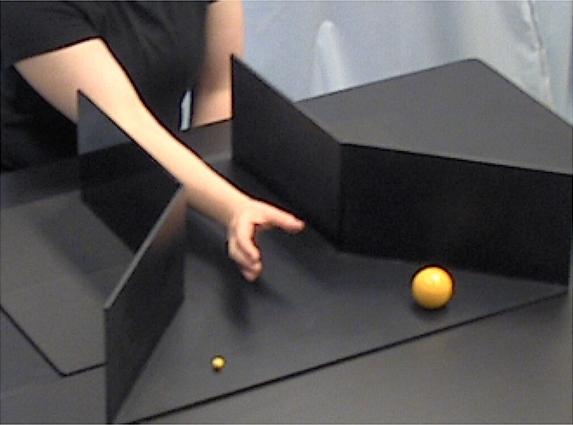
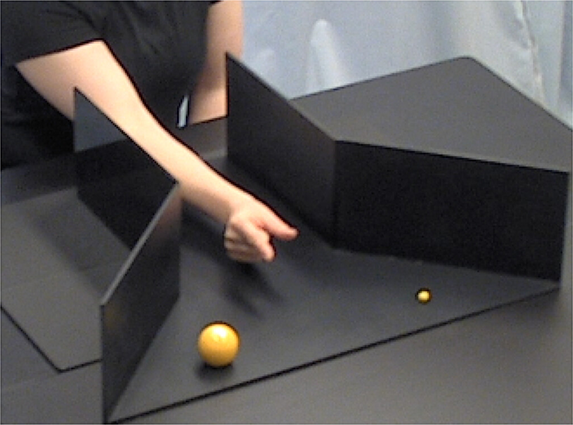
The researchers then recorded how long babies spent looking at the object that fit the type of grip the experimenter was using. In other words, they tested whether the infant would look at the small object if the adult was showing a precision grip and the large object if the adult was using the power grip. They found that the time babies spent looking at the object that matched the experimenter’s grip was most impacted when two things co-occurred in the study – when the baby had good fine motor skills and when their own grip was gently restricted while they were watching the adult. This suggests that babies use a complex series of cues to try to understand what the adult’s goals are. When the baby is restricted from trying out or imagining the adult’s movements with their own hands, it impedes their understanding of what the adult is doing.
Dr. Meltzoff said, “The babies use their own actions to understand the actions of other people. If we temporarily block infants’ ability to use their hand to make different grips, they have a harder time understanding other people’s reaching-and-grasping. It seems that they work out the meaning of other people’s actions by using their own bodies. They think: ‘If I had made a precision grip, I would be reaching for the small object. If the adult makes a precision grip, that’s probably the adult’s goal too.’ Interestingly, they understand others through analogy with themselves. They’re being very clever, even before they can say their first words!”
The scientists would like to extend this work by studying other aspects of infant motor development and testing whether they also influence how infants understand other people. And they want to use safe neuroscience techniques to watch what’s happening in the baby brain during these studies.
Dr. Ní Choisdealbha received funding from the prestigious Marie Skłodowska-Curie Fellowship, a program that funds the development and training of outstanding young scientists. She chose to work at I-LABS because of the opportunities to do advanced research on the development of mind-brain functioning at this institute.
Read the paper: Exploring 12-Month-Old Infants’ Processing of Other People’s Manual Actions: A Motor Interference Paradigm
Explore and infographic about infant motor skill development created through a collaboration between Dr. Choisdealbha and the I-LABS Outreach Team: Unlocking Motor Milestones
Further reading: Advances in understanding the perception-production link: Evidence from infant eye, brain, and motor behavior